VALICON TOP BRANDS 2025
Check the ranking of the 100 strongest FMCG brands in the Adria region.
Request more info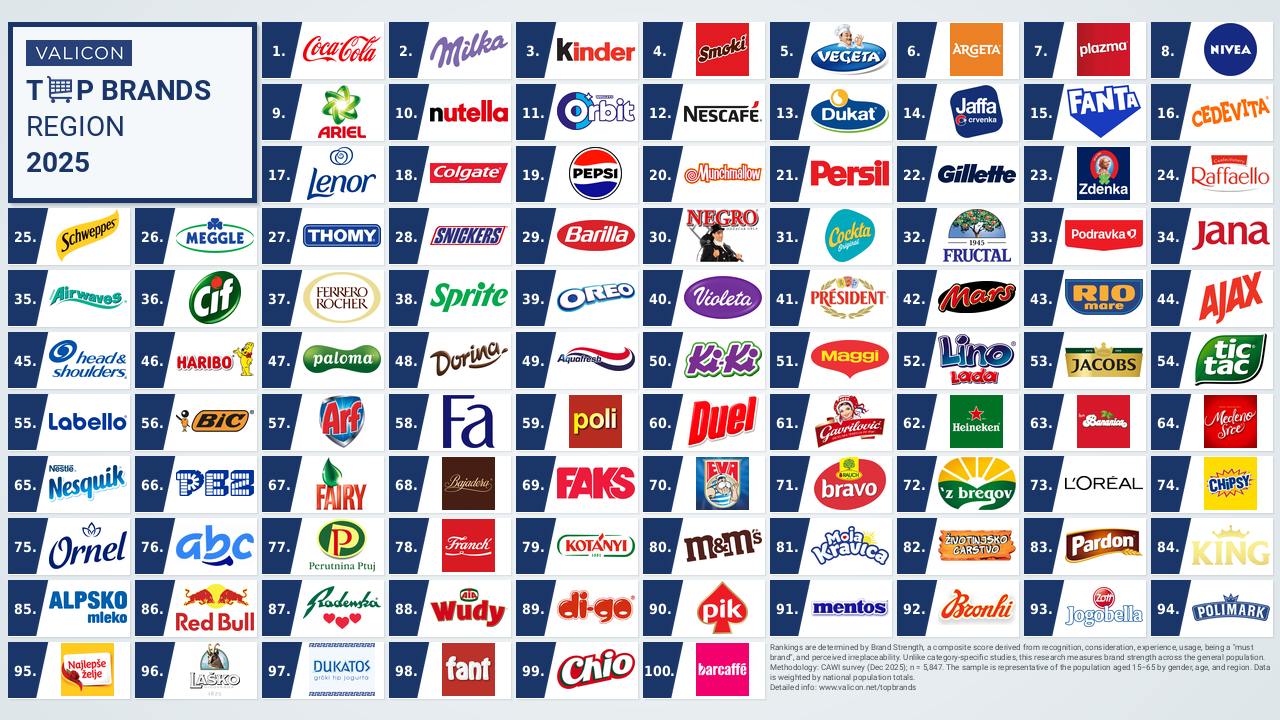
Why does TOP BRANDS research represent an objective measure of brand success?
1. Key New Indicator
IRREPLACABLE BRAND
Brand strength is calculated based on awareness, experience, usage, and now also must-brand and irreplaceability status. The strongest brands practically all score above 90% on the lower levels, which is why we upgraded the power measurement with a crucial additional indicator: indispensability.
2. The Bigger Picture
BRAND WITH EXTENSIONS
We no longer treat brands only within a single category. Our modern approach understands the brand more broadly, as a consumer brand with all its extensions. This finally allows us to recognize the brand as a whole and the true power it commands in the market.
3. Visual Approach
MEASUREMENT WITH LOGOS
In the age of mobile applications, we have adapted our tools. Instead of reading names, we use brand logos, as visual recognition has become a crucial part of the brand experience.
4. The True Test of Strength
FULL MARKET POWER
We measure brand strength on the entire representative sample in Slovenia, Croatia, Serbia, Bosnia and Herzegovina, Northern Macedonia, Montenegro, and Kosovo (n=500-1000 per country), not just on category users.
5. Brand Selection
FULL TRANSPARENCY
Brand selection (100–220 per country) is based on: 1. previous measurements, 2. regional strength, and 3. spontaneous recall results 4. complemented by direct industry suggestions.
In-Depth Methodology Overview
Brand Definition
Our 2025 methodology shifts toward a holistic brand definition, capturing the brand as a single consumer entity along with all its extensions, including those into different categories. We added the latter element due to the increasingly common strategy of expanding brands into new categories. This is a legitimate and bold strategy aimed at leveraging brand power in core categories while simultaneously adding to the overall strength of the brand. In the past, it was standard practice to treat a brand in each category separately. For example, Frikom in Serbia, or Ledo in Croatia, appeared in frozen vegetables, frozen ready-made meals, and ice cream; Zvijezda in Croatia in oil, margarine, and mayonnaise...
Brand Logic: Identity, Extensions & Hero Brands
Corporate brands do not belong on the list. Exceptions are cases where a company uses a "corporate brand" for a large part of its portfolio. Such examples include Podravka, Žito, Jaffa, and Klas in BiH. In cases where we have a brand and an independent strong brand with its own visual identity under a subordinate signature of the parent brand, we use both brands—for example, President and Somborska in Serbia. In cases where we have an extended brand still in the making but one or more strong "hero brands" (e.g., Lino lada and Lino, or Multisola and Sola), we use those that are stronger—usually the "hero" brands. If a strong brand is in the process of rebranding, both logos are used in the research, and the stronger one is placed on the list—example: Prince caffe Kosovo. The power of "hero brands," which are typically stronger than the master brand, represents an important insight for managing brand architecture.
Visual Recognition: Measuring Brands as Consumers See Them
Beyond the visual shift driven by mobile apps, our exclusive use of logos replicates how consumers actually navigate the market. In a split second at the store shelf, a consumer doesn’t read a brand name—they recognize a visual pattern. By testing visual assets directly, we measure a brand's instinctive power and its ability to cut through the noise. This approach ensures our data reflects actual purchase behavior and the brand’s immediate impact in a cluttered retail environment.
Brand Strength & Category Dynamics
Brand strength is calculated as a comprehensive average of six key indicators: recognition, consideration, experience, usage, perception of a "must-brand," and perceived indispensability (the latter two specifically measuring brand resilience against market fragmentation and the pressure of private labels). Crucially, this index is calculated across the entire representative sample—not just among category users. Due to this, it is difficult to find brands among the strongest in categories without wide distribution (e.g., cigarettes, strictly female or male products or high premium segments). Rankings also mirror the development of a category; some have less pronounced leaders, while brands in oligopolistic categories, such as beer, face significant challenges.
A True Market Mirror: Representative & Reliable Data
In the last ten years, internet penetration has risen above 90%, and COVID further increased the usage rate. The survey is thus conducted entirely online among members of the Opinia.Club (formerly JazVem) web community, where individuals are selected to form a representative sample of the 15–65 age population. The sample size is at least n=500 in smaller markets and at least n=1000 in the larger markets of the region.
Market Proportions: Balancing Regional Scale and Impact
Ranking on the list of the 100 strongest regional brands VALICON TOP BRANDS is not easy. Regional brand strength is a weighted average of brand strength in each individual country, where the weights are estimates of the 15–65 population size: Montenegro has the lowest weight at 0.39, while Serbia has the highest at 4.12. Due to the population size, brand strength in Serbia has the greatest impact on regional brand strength. Consequently, brands from categories where local players strongly dominate in individual markets find it harder to rank on the overall regional list of the strongest.
Transparent Selection Logic
The selection of brands for the list in the survey is as transparent as possible. We start from the previous measurement, placing all brands that were at least among the top 100 on the national list. To this, we add all missing brands that were among the top 50 on the regional list. Finally, we look at the results of a separate spontaneous recall study and add brands that appear there but are not on the list. Before the start of the implementation, companies were additionally invited to suggest their brands. To ensure a truly comprehensive overview the final lists used comprise roughly 220 brands per country.
Research Timing
The research was conducted in December 2025, which is inevitably reflected in the results: some typically “winter” brands are stronger, while “summer” brands (e.g., beverages and ice cream), which previously occupied higher positions due to a September timeframe, are in the background this time. Regarding the future, we can already announce that we are preparing a methodological upgrade that will completely eliminate this seasonal influence in the next measurement cycle.
*From all the above, it is clear that the methodology changed so significantly in 2025 that the results cannot be compared with the TOP BRANDS 2016 results.
Frequently Asked Questions (FAQ)
It is a benchmark regional study that evaluates the strength of FMCG brands. It's returning after a decade with an improved methodology to address the current market landscape.
The rise of discounters, the expansion of private labels, and shifts in consumer behavior have made it necessary to look at brands more holistically, beyond just their performance within a single category.
The research now covers all seven markets in the Adria region, assesses the entire brand including its extensions, uses logos for brand recognition, and adds "irreplaceability” as a crucial new indicator of brand strength.
Inclusion provides public recognition of your brand's strength, validates its market position, and offers access to exclusive, in-depth reports and strategic analyses with unique regional insights.
The methodology is the most transparent and designed for today's market. It incorporates a new "irreplaceability" metric to distinguish top-tier brands, considers the brand as a whole, and uses a visual-first approach with logos, reflecting how modern consumers interact with brands.
The research is conducted by VALICON, a marketing research company focusing on Adria region for more than 25 years, cooperating with most of the bigger brands and the retailers in this region. VALICON operates the biggest profesionnal access panel in all of the countries Opinia.Club.
A list of brands is automatically included based on their performance in previous studies and spontaneous recall data. If your brand is not on this initial list, you can have it included for a symbolic listing fee (200 EUR / brand country).
Customized in-depth reports, specific insights, and portfolio analysis across all countries are available as a premium service. You can contact the research team for a special offer.
The research methodology has been significantly updated to reflect the current market. Here are the key components:
- Expanded Geographic Scope: The study now covers all seven markets of the Adria region: Slovenia, Croatia, Serbia, Bosnia and Herzegovina, Northern Macedonia, Montenegro, and Kosovo.
- Holistic Brand Definition: A brand is evaluated as a whole, including all its horizontal (cross-category) and vertical (price/quality tier) extensions. This provides a comprehensive view of the brand's overall strength.
-
Four-Pillar Brand Strength Measurement: Brand strength is calculated based on four key indicators:
- Recognition: How well-known the brand is.
- Experience: How many consumers have tried the brand.
- Usage: How many consumers regularly use the brand.
- Irreplaceability: A new metric that measures how essential the brand is to consumers, separating top brands from truly irreplacable ones.
- Modern Data Collection: The survey is conducted online with a representative sample of the population aged 15-75 in each country using Opinia.Club professional online panels. To reflect the visual nature of shopping, the survey uses brand logos instead of just names.
- Transparent Brand Selection: The initial list of brands to be measured is created based on their performance in previous studies and spontaneous recall surveys. Additionally, clients can pay a listing fee to have their brands included, ensuring that any brand can be part of the research.
The research is returning after a ten-year hiatus because the market has changed dramatically and there is a need for new understanding of the FMCG brands landscape. The rise of discounters, the growth of private labels, and shifts in consumer behavior required a complete overhaul of the research methodology. The previous approach was no longer sufficient to capture the true strength of brands in the current landscape.
Being listed in the TOP BRANDS research offers several key benefits:
- Public Recognition: It provides public visibility and confirms your brand's strength and status in the market.
- Business Credibility: The listing serves as a credible endorsement that can be used to strengthen relationships with retailers and other market operators.
- Strategic Insights: You gain access to exclusive, in-depth reports and strategic analyses with unique regional insights that are not available anywhere else.
The final deadline for inclusion in this year's research is December 10th, 2025. Data collection will be conducted in mid December 2025. The results will be published in the first beginning of Februrary.
If your brand is not on the initial list, you can propose it for addition. The research team is open to nominations and will review your brand to see if it meets the criteria for inclusion. In some cases, a listing fee may apply. You should submit your email to be contacted by a local expert who will guide you through the process.
- The final deadline for inclusion in this year's research is December 10th, 2025.
- Status verification for your brand is free. If your brand automatically qualifies for the list, inclusion is also free.
- For brands that do not automatically qualify, a symbolic listing fee (200 EUR / country brand) is charged to cover the additional costs of expanding the research.
- In-depth reports, benchmarking, and strategic analyses are also available for a fee.
The research is designed to evaluate a company's entire brand portfolio. More brands means more listings. If the company has some brands not listed yet, it needs to apply for them to be added.
Absolutely not. Being ranked on the TOP 25 list is a huge success. In the measurement there are already 500 brands that were carefully selected. The research is designed to be a strategic tool for brand improvement, not a public critique. A low ranking should be viewed as a valuable opportunity to identify areas for growth and to better understand your brand's position in the market. The detailed analysis provides the insights needed to improve your brand's strength and ranking in the future.